
Medically reviewed by Barbra Scheirer,
Psychiatric Mental Health Nurse Practitioner at Mighty Mental Health
Last medically reviewed: October 19, 2026
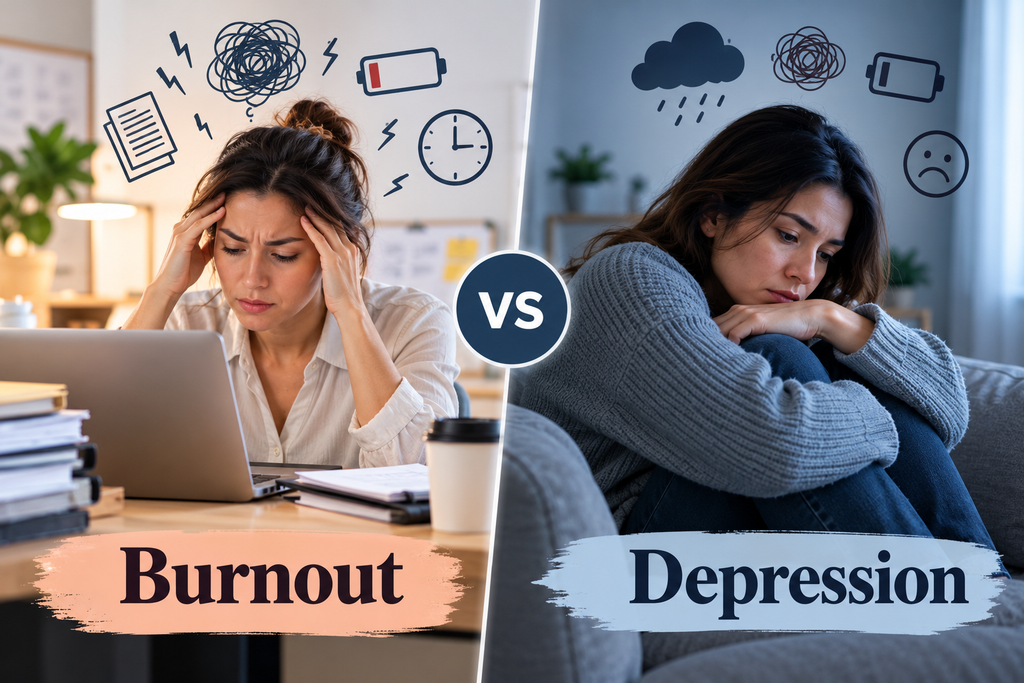
Burnout is job-related exhaustion that often eases when stress changes, while depression is a clinical mood disorder affecting all areas of life and needing professional care.
Plenty of people search burnout vs depression at 2 a.m., worn out, unmotivated, and unsure which one they are dealing with. The confusion makes sense. Both can leave you exhausted, irritable, and struggling to focus.
The difference matters because the right next step depends on the right answer. Burnout often improves when the source of stress changes. Depression usually does not, and untreated depression can become dangerous. This guide explains how the two conditions differ, where they overlap, and when it is time to talk to a professional.
What Is Burnout?
Burnout is a state of physical and emotional exhaustion that builds up from long-term, unmanaged stress, most often at work. It rarely arrives overnight. It creeps in through months of heavy workloads, little control, and too little recovery.
How the WHO Defines Burnout
The World Health Organization includes burnout in the International Classification of Diseases (ICD-11), but it classifies it as an occupational phenomenon, not a medical diagnosis. The WHO describes three parts: feelings of energy depletion or exhaustion, increased mental distance or cynicism toward one’s job, and reduced professional efficacy. Researcher Christina Maslach, whose work shaped this definition, has long argued that burnout is as much about the workplace as the person.
Who Is Most at Risk?
Burnout shows up in any field, but it is especially common among healthcare workers, teachers, caregivers, and anyone whose job demands constant emotional output.

What Is Depression?
Depression, or major depressive disorder, is a clinical mood disorder with defined diagnostic criteria. According to the DSM-5-TR, a diagnosis requires at least five symptoms present during the same two-week period, and at least one must be either depressed mood or loss of interest or pleasure.
Why Depression Is Not Just Sadness
Depression is not a bad week or a reaction that lifts once things calm down. It changes how a person thinks, sleeps, eats, and relates to others. It often appears without a clear trigger, and it follows a person from the office to the dinner table to the weekend. Some people even hide it well, a pattern known as high-functioning depression.
Burnout vs. Depression: Key Differences at a Glance
| Factor | Burnout | Depression |
| Cause | Chronic work or caregiving stress | Biological, psychological, and environmental factors, sometimes with no clear trigger |
| Main symptoms | Exhaustion, cynicism, reduced performance | Persistent low mood, loss of interest, hopelessness |
| Scope | Mostly tied to work or one role | Affects all areas of life |
| Duration | Often improves when stressors change | At least two weeks, often longer without treatment |
| Diagnosis | Not a medical diagnosis (WHO) | Clinical diagnosis by a licensed provider |
| Treatment | Rest, workload changes, boundaries, support | Therapy, medication when appropriate, or both |
When people compare depression vs burnout, scope is usually the clearest dividing line. Burnout tends to stay attached to one part of life. Depression does not stay in its lane.
Burnout Symptoms
Burnout symptoms tend to cluster around three areas.
Exhaustion
You wake up tired and stay tired. Sleep does not fully restore you, and small tasks feel heavy.
Cynicism or Detachment From Work
You stop caring about outcomes you once cared about. Coworkers feel like obstacles, and the job starts to feel pointless. A teacher who once loved lesson planning may begin dreading every Sunday night.
Reduced Performance
Focus slips, mistakes creep in, and work that took an hour now takes three. Many people also report headaches, stomach trouble, or getting sick more often.

Depression Symptoms
Depression symptoms reach beyond the job and can include extreme fatigue. Common signs include:
- Persistent low or empty mood most of the day, nearly every day
- Loss of interest in activities you once enjoyed, including hobbies and time with friends
- Changes in sleep, either insomnia or sleeping far more than usual
- Changes in appetite or weight
- Feelings of worthlessness or excessive guilt
- Hopelessness about the future
- Trouble concentrating or making decisions
- Thoughts of death or self-harm
If you are having thoughts of harming yourself, call or text 988, the Suicide and Crisis Lifeline, or go to the nearest emergency room.
Can Burnout Turn Into Depression?
It can. Burnout is not a form of depression, but long-term exhaustion and hopelessness can wear a person down until a depressive episode develops. Research has found that burnout and depressive symptoms often travel together, and people with prolonged, untreated burnout face a higher risk of later depression.
Warning signs that burnout may be shifting include feeling low even on days off, losing interest in things outside work, and a growing sense of worthlessness rather than just frustration with the job.
Can You Have Burnout and Depression at the Same Time?
Yes. The two conditions can overlap, which makes self-diagnosis unreliable. Someone can be burned out at work and also meet criteria for a depressive disorder, and each can make the other harder to manage.
Depression vs Autistic Burnout
Another comparison worth knowing is depression vs autistic burnout. Autistic burnout is not the same as workplace burnout. Autistic adults describe it as a state of intense exhaustion, loss of skills, and reduced tolerance for sensory input that follows years of masking and overload. It is not a formal diagnosis, and it can look a lot like depression from the outside. Because the causes and best supports differ, a clinician experienced in autism treatment is important here.
How Do You Know If It’s Burnout or Depression?
Only a licensed clinician can give you an accurate diagnosis, but these questions can help you notice patterns before an appointment:
- Does my low mood improve on vacations or weekends, or does it follow me everywhere?
- Do I still enjoy things outside work, like friends, hobbies, or food?
- Is my exhaustion tied mainly to my job, or do I feel flat about everything?
- Am I sleeping or eating very differently than I normally do?
- Do I feel hopeless, worthless, or like others would be better off without me?
- Have these feelings lasted two weeks or longer?
If most of your answers point to problems across your whole life, or if any answer involves hopelessness or self-harm, please reach out to a professional soon, and look into help for depression near you. You do not need to wait until you are sure.

Treatment Options for Burnout vs. Depression
Treating Burnout
Burnout treatment starts with changing the conditions that caused it. That can mean real rest, a lighter workload, clearer boundaries, flexible scheduling, or a conversation with a manager. Therapy can help with stress management and with rebuilding a healthier relationship with work.
Treating Depression
Depression treatment is more structured. Evidence-based treatment options include psychotherapy such as cognitive behavioral therapy, medication management when clinically appropriate, or a combination. A prescriber reviews symptoms, history, and other medications before recommending anything, and many patients ask how antidepressants work before starting.
Learn More About Depression Treatment in Las Vegas
Understanding burnout vs depression is the first step. Getting the right care is the next one. If you are unsure which one you are facing, a professional evaluation can sort it out and point you toward depression treatment that fits.
Mighty Mental Health is a psychiatry and medication management office serving Las Vegas and Summerlin, NV, with telehealth visits and in-office consultations. Our Psychiatric Nurse Practitioner, Barbra Scheirer, provides comprehensive treatment plans for conditions like burnout-related distress and depression, which may include prescribing medication or recommending therapy as part of a well-rounded approach to care. We accept Nevada Medicaid, CareSource, Silver Summit, Health Plan of Nevada, Molina, and Anthem. Review our accepted insurance plans before booking.
Contact us today at 702-479-1600 or through our contact form to schedule your visit.

Frequently Asked Questions
Is burnout a mental illness?
No. The WHO classifies burnout as an occupational phenomenon, not a medical condition. That said, it can seriously affect mental health and may develop into depression or anxiety if ignored.
Can burnout cause depression?
It can contribute. Prolonged burnout raises the risk of a depressive episode, especially when exhaustion turns into hopelessness that spreads beyond work.
Will a vacation fix burnout? Will it fix depression?
A vacation can ease burnout temporarily, but the relief fades if the workload stays the same. It will not fix depression, since depression usually follows a person wherever they go.
Can burnout be treated with medication?
Burnout itself is not treated with a specific medication. However, if burnout comes with depression, anxiety, or insomnia, a provider may recommend medication for those conditions alongside therapy and lifestyle changes.
References
- World Health Organization. Burn-out an “occupational phenomenon”: International Classification of Diseases. May 28, 2019. https://www.who.int/news/item/28-05-2019-burn-out-an-occupational-phenomenon-international-classification-of-diseases
- American Psychiatric Association. Diagnostic and Statistical Manual of Mental Disorders, Fifth Edition, Text Revision (DSM-5-TR). 2022.
- Maslach C, Leiter MP. Understanding the burnout experience: recent research and its implications for psychiatry. World Psychiatry. 2016;15(2):103-111. https://doi.org/10.1002/wps.20311
- Koutsimani P, Montgomery A, Georganta K. The relationship between burnout, depression, and anxiety: a systematic review and meta-analysis. Frontiers in Psychology. 2019;10:284. https://doi.org/10.3389/fpsyg.2019.00284
- Raymaker DM, Teo AR, Steckler NA, et al. “Having all of your internal resources exhausted beyond measure and being left with no clean-up crew”: defining autistic burnout. Autism in Adulthood. 2020;2(2):132-143. https://doi.org/10.1089/aut.2019.0079
- 988 Suicide & Crisis Lifeline. https://988lifeline.org