
Medically reviewed
by Barbra Scheirer, Psychiatric Mental Health Nurse Practitioner at Mighty Mental Health Last medically reviewed: August 18, 2026
Nevada Medicaid gives eligible low-income adults, children, seniors, pregnant individuals, and people with disabilities free or low-cost health coverage, including doctor visits.
Healthcare costs are one of the biggest worries for families, seniors, and individuals across Nevada. Medicaid exists to ease that burden, but two questions come up more than any others: who actually qualifies, and what does the coverage include? The honest answer is that eligibility is broader than most people assume, and the benefits go far beyond emergency care. Many residents assume Medicaid is reserved strictly for families living far below the poverty line, but between income-based expansion, disability provisions, and pregnancy-related coverage, a much wider group of Nevadans qualifies than the stereotype suggests.
This guide walks through both sides of the picture, who can qualify for Nevada Medicaid, what it covers, how to apply, and what to do if you don’t initially qualify so you can make informed decisions about your family’s healthcare.
What Is Medicaid in Nevada?
Medicaid is a joint federal and state program that provides low-cost or free health coverage to eligible individuals and families. In Nevada, the program is administered by the Division of Health Care Financing and Policy (DHCFP) and partners with local healthcare providers throughout the state. Since Nevada adopted Medicaid expansion under the Affordable Care Act, significantly more adults have become eligible, and the scope of covered services has grown along with it.
Unlike many private insurance plans, Nevada Medicaid often covers services that other coverage overlooks, including behavioral health treatment, long-term care, and specialized therapy programs. That makes understanding both eligibility and coverage the first step toward using the program effectively.
It’s also worth knowing that Medicaid coverage in Nevada isn’t a one-time approval. Beneficiaries typically go through periodic eligibility redeterminations, meaning the state reviews income and household information at set intervals to confirm continued eligibility. Missing a renewal notice is one of the most common, and most avoidable, reasons people lose coverage they still qualify for, so keeping contact information updated with DHCFP matters just as much as the original application.
Who Qualifies for Medicaid in Nevada?
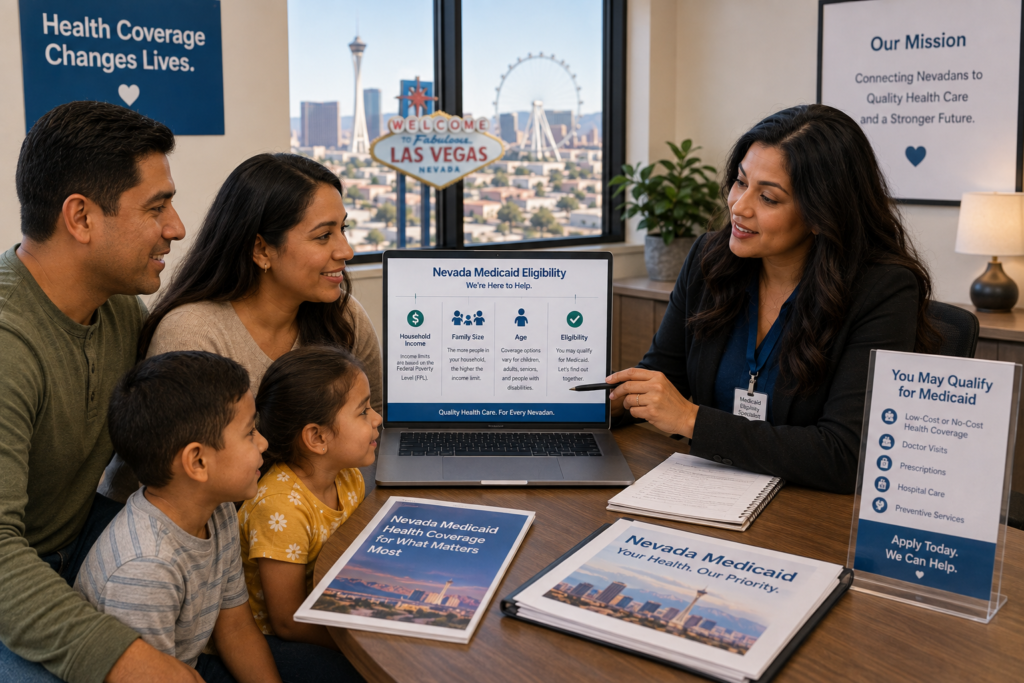
Eligibility depends on a combination of income, household size, age, disability status, and other personal circumstances. Because the rules aren’t static, someone who doesn’t qualify based on income alone may still become eligible through pregnancy, disability, or a change in household size.
Groups That Commonly Qualify
- Low-income adults — Adults ages 19–64 with incomes at or below 138% of the Federal Poverty Level (FPL).
- Children and teens — Medicaid and Nevada Check Up (the state’s CHIP program) provide coverage for kids who don’t otherwise qualify for full Medicaid.
- Pregnant individuals — Coverage extends through pregnancy and continues for a period postpartum, covering prenatal visits, delivery, and follow-up care.
- Parents and caregivers — Eligibility depends on household size and income, ensuring caregivers can access healthcare while supporting dependents.
- Seniors — Adults 65 and older may qualify based on financial and medical criteria, often supplementing Medicare coverage.
- People with disabilities — Medicaid covers specialized treatments, long-term care, and nursing home services for those who meet disability criteria.
Nevada offers online screening tools to help estimate eligibility before formally applying, which can save time and set realistic expectations. It’s also worth noting that eligibility is assessed per person within a household, not just at the household level, so it’s possible for one family member to qualify for full Medicaid while another qualifies for Nevada Check Up, or for a parent’s eligibility to differ from their child’s. Reviewing each household member’s situation individually, rather than assuming one outcome applies to everyone, is one of the most overlooked steps in the process.
What Does Medicaid Cover in Nevada?
Once eligibility is established, the next question is what does Medicaid cover in Nevada. The program is built to support both urgent needs and long-term wellness, which is part of why it plays such a large role in the state’s healthcare system.
Services Typically Included
- Primary and specialist care — Routine checkups, annual physicals, preventive screenings, and referred specialist visits.
- Hospital services — Inpatient stays, outpatient surgeries, and emergency room visits.
- Prescription medications — Coverage follows an approved drug formulary to ensure access to necessary medications.
- Mental health care — Psychiatric evaluations, therapy sessions, and medication management.
- Maternity and newborn services — Prenatal care, delivery, and newborn screenings.
- Rehabilitation and therapy — Physical, occupational, and speech therapy following illness or injury.
- Durable medical equipment — Wheelchairs, oxygen equipment, and diabetic supplies when medically necessary.
- Non-emergency medical transportation — Available for patients who can’t otherwise reach appointments.
By covering wellness visits and screenings alongside emergency care, Nevada Medicaid helps catch health issues early, often preventing more costly hospitalizations later. For example, a routine screening that flags high blood pressure or early signs of diabetes can lead to manageable treatment through medication and lifestyle changes, rather than an emergency room visit years down the line. That preventive-first structure is one of the biggest practical advantages Medicaid offers over having no coverage at all.
Medicaid and Medicare Together for Seniors
Many seniors in Nevada qualify for both Medicare and Medicaid at the same time, a situation often called “dual eligibility.” In these cases, Medicaid can help cover costs Medicare doesn’t fully pay for, such as long-term nursing home care, certain prescription costs, and copayments. For seniors on a fixed income, this combination can make the difference between manageable healthcare costs and a genuine financial strain, which is why it’s worth checking dual-eligibility status even if a senior already has Medicare.
Dental and Vision Coverage
Coverage for dental and vision depends heavily on age. Children under 21 receive full benefits under federal law, including cleanings, fillings, braces when medically necessary, eye exams, and eyeglasses. For adults, coverage is more limited, dental services typically focus on emergencies like extractions or treating severe infections, while vision coverage usually applies to medically necessary eye exams, particularly for patients managing conditions like diabetes or glaucoma. Routine adult cleanings and glasses aren’t always included, so it’s worth confirming specific benefits before booking an appointment.
Costs and Limitations to Know
Most Medicaid beneficiaries pay no monthly premium, and copays, when they apply, such as for brand-name prescriptions, are kept intentionally low. That said, the program has real boundaries. Not every provider accepts Medicaid, so confirming participation before scheduling is worthwhile, a quick call to the provider’s office asking whether they’re currently accepting new Medicaid patients can save a wasted trip. Some benefits, like physical therapy, may be capped annually, and certain procedures or specialized medications require prior authorization before coverage kicks in, which can add a few extra days to the approval timeline for non-urgent care. These limitations are minor compared to the financial protection Medicaid provides against the cost of being uninsured, but understanding them upfront helps patients plan around them instead of being caught off guard mid-treatment.
How to Apply for Medicaid in Nevada
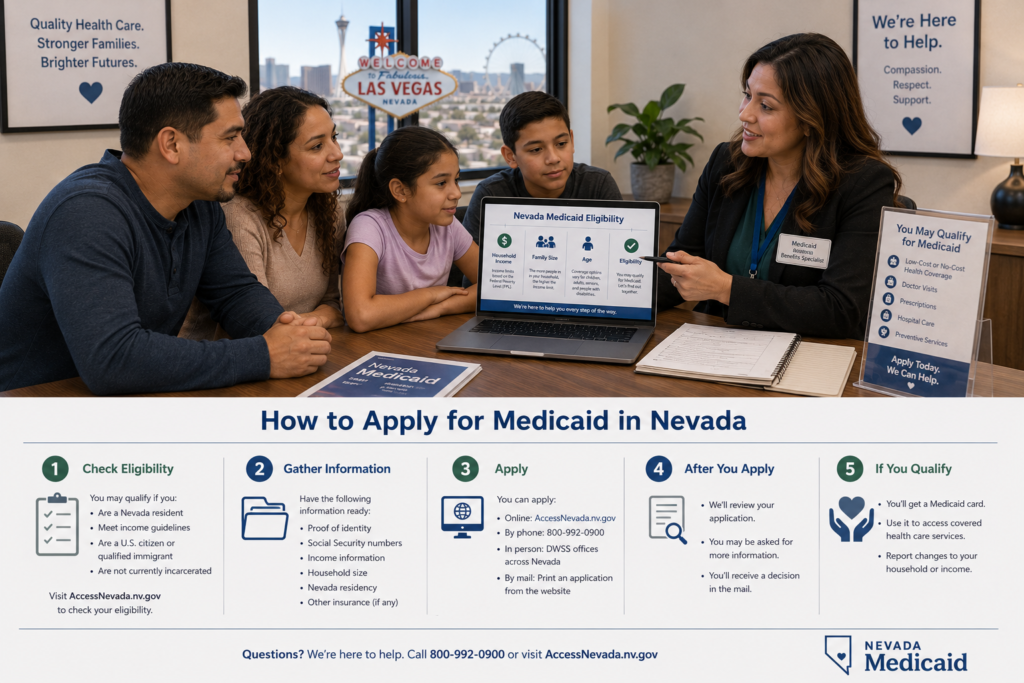
Applying is more manageable than it might seem, especially with the right documents on hand.
- Gather your documents — Proof of identity, income, Nevada residency, and household size (pay stubs, tax returns, utility bills, birth certificates).
- Complete the application — Apply online through Nevada’s Health Insurance Marketplace, in person at a local Medicaid office, or by mail. Online applications are typically processed fastest.
- Submit and verify — Make sure every form is complete and every document is attached, since incomplete applications slow down processing.
- Wait for determination — The state reviews the application and may reach out for additional information.
- Receive your coverage details — Approved applicants get a Medicaid ID, a summary of covered services, and a list of participating providers.
Common Reasons Applications Get Denied
Denials often come down to a handful of fixable issues: household income exceeding the limit for the applicant’s category, missing documentation, residency problems, applying under the wrong eligibility category, or failing to respond to a state request for more information. A denial isn’t necessarily final, applicants can appeal, submit missing paperwork, or work with a Medicaid navigator to reapply successfully.
If You Don’t Qualify
Medicaid isn’t the only path to affordable care. Marketplace insurance plans may offer income-based subsidies, Nevada Check Up covers children and young adults outside Medicaid’s income limits, and Federally Qualified Health Centers often provide sliding-scale fees based on what a patient can actually afford. Employer-sponsored insurance and local charity or nonprofit programs can also help fill the gap. It’s also worth reapplying if circumstances change, a reduction in work hours, a new pregnancy, or a household member’s diagnosis can all shift eligibility even if the original application was denied.
How Mighty Mental Health Can Help
Whether you’re confirming eligibility or trying to understand what your Medicaid plan covers, navigating Nevada Medicaid doesn’t have to be something you figure out alone. At Mighty Mental Health, we accept Nevada Medicaid along with CareSource, Silver Summit, Health Plan of Nevada, Molina, and Anthem, so patients can access mental health care without worrying about coverage limitations.
Our Psychiatric Nurse Practitioner, Barbra Scheirer, provides compassionate evaluations, medication management, and therapy recommendations tailored to each patient, whether they’re managing ADHD, depression, anxiety, or another concern. We offer both telehealth visits and in-office consultations in Las Vegas and Summerlin, NV, so care fits your schedule and comfort level.
If you’re covered by Medicaid, or want help understanding whether you qualify, contact us today at 702-479-1600 or through our online contact form to schedule an appointment.
Frequently Asked Questions
How do I know if I qualify for Nevada Medicaid?
Eligibility is based on income, household size, age, disability status, and circumstances like pregnancy. Using Nevada’s online screening tool is the fastest way to get a preliminary answer before submitting a full application.
Does Nevada Medicaid cover mental health services?
Yes. Psychiatric evaluations, therapy sessions, and medication management are all included under Nevada Medicaid, making it a viable option for patients seeking ongoing behavioral health support.
What should I do if my Medicaid application is denied?
Review the denial notice for the specific reason, gather any missing documentation, and either appeal the decision or submit a new application. Many denials stem from fixable issues like incomplete paperwork rather than a true lack of eligibility.
Can adults get dental coverage through Nevada Medicaid?
Adult dental coverage is limited compared to children’s benefits, generally focusing on emergency treatment like extractions or infections rather than routine cleanings. Checking current plan details before scheduling is recommended.
References
- Nevada Medicaid — Division of Health Care Financing and Policy (DHCFP), nevadamedicaid.nv.gov
- DHCFP — Programs and Eligibility Overview, dhcfp.nv.gov
- Access Nevada — Official Medicaid Application Portal, accessnevada.nv.gov
- Nevada Health Link — Medicaid Eligibility and Marketplace Alternatives, nevadahealthlink.com
- Medicaid.gov — Nevada State Overview, medicaid.gov